
Author: Ty Druse
On seedtoinvest.com, I’m often asked, “What is the best investment?” or “Why not just place all of your money in the S&P 500?” This article evaluates those questions through the lens of one broad-market ETF that qualifies as an all-purpose investment. I define “all-purpose” here as a single ETF that serves as a core holding across both taxable and retirement accounts without requiring the investor to purchase multiple funds. While I’m not a certified financial planner or certified public accountant, I enjoy investing and sharing my ideas.
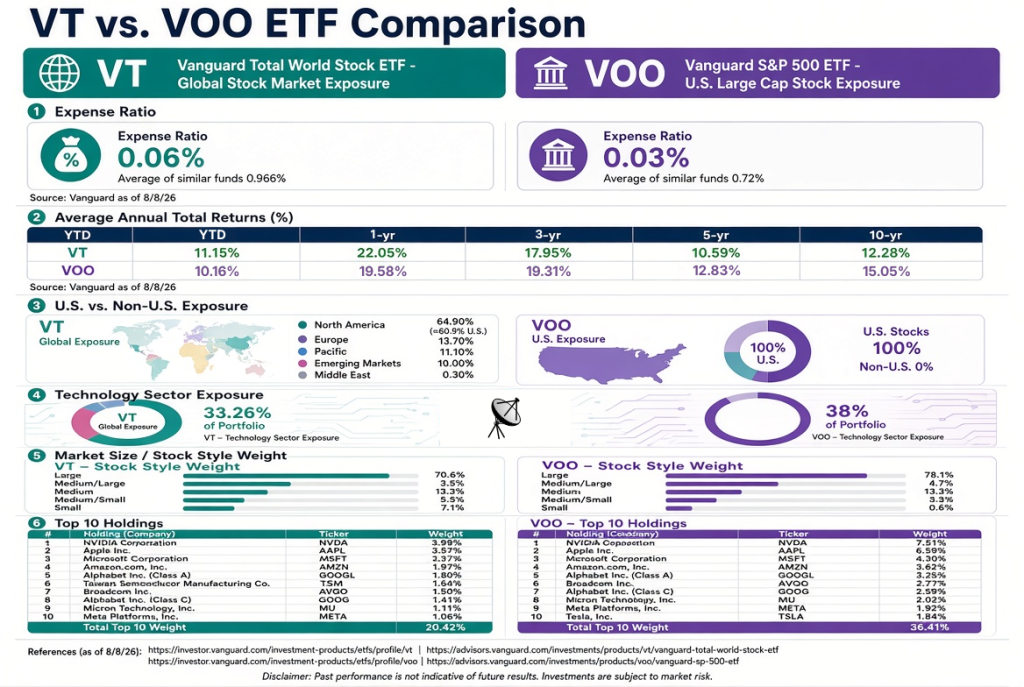
One exchange-traded fund (ETF) stands out due to 1) low expense ratio, 2) historical returns, 3) diversification, and 4) market-cap mix. If you were told about an investment that has an expense ratio of 0.06%, 1-year return of 22.05%, annualized 10-year return equaling 12.28%, broad investment exposure, and small/mid/large-cap market exposure, wouldn’t that sound like an ideal ETF?
The above description is Vanguard’s Total World Stock ETF (VT). With an expense ratio of 0.06%, it is significantly lower than many peers (according to Vanguard, the Lipper peer average expense ratio is 0.966% for similar funds). A fee totaling 0.06% is exceptionally low and will assist investors in retaining more of their investment returns for compound growth. To put it in perspective, with a $10,000 investment in VT, the annual fees would equal six dollars. If you are interested in learning more about the effects of expense ratios, review this article [Compound Interest’s Silent Killer].
Secondly, look at the historical comparison of VT versus S&P 500 (VOO) in the chart below. VT has outperformed VOO recently, but has shown slightly lower annualized returns compared to VOO over the past decade.
Next, diversification is an important topic. VT is a little over 60% U.S. market with the remainder invested internationally, while VOO is 100% U.S. equities. Many recommend investing solely in the S&P 500 (VOO), but is an investment with only U.S. assets wise? There are two items to consider with this point; national debt and high valuations. The current U.S. national debt is high; according to Peter G. Peterson Foundation, the ratio of national debt to GDP is currently over 100% (equaled 106.1% after WWII) or approximately $117,030 per American. A high national debt may result in higher taxes (personal or corporate) and/or higher interest rates, which have historically affected stock prices. Additionally, U.S. stock market prices have soared in recent years. According to the “Buffett Indicator” by the website Current Market Valuation, the U.S. stock market is 2.1 standard deviations above historical trend lines. Because of concerns about the national debt and higher than normal valuations, I have been diversifying away from the U.S. market into fund(s) that include international exposure. I personally strive for a 50% U.S. and 50% international mix.
Lastly, to increase a portfolio’s diversification, mid and small-cap allocations can be added, as they reduce exposure to mega-cap tech heavy stocks. In reviewing the chart again, look at the percentages of large, mid, and small-cap stock allocations that are higher in VT compared to VOO. The chart also reveals that VOO has over 36% concentrated in 10 mega-cap, tech-heavy stocks. VT is far more diversified by providing investors a greater percentage of mid and small-cap stocks. The all-purpose ETF investment vehicle for taxable and retirement accounts, in my opinion, is VT. VT is truly an exceptional ETF that should be considered as a foundational allocation for many investors looking for a broad-market, low-cost, diversified core holding.
References: (Sources accessed August 13, 2026): https://investor.vanguard.com/investment-products/etfs/profile/voo
https://investor.vanguard.com/investment-products/etfs/profile/vt
Leave a Reply