
Author: Ty Druse
Habits can be positive, negative, or some place in between. This article will focus on successful habits that generate wealth. In a previous article on compound interest, it was noted that investing $1,000 annually or $83.33 per month in a low-cost, broad-based ETF over 50 years resulted in approximately $1.5 million (S&P 500 average return over past 50 years). The biggest levers anyone can pull when pursuing millionaire status are consistency and time.
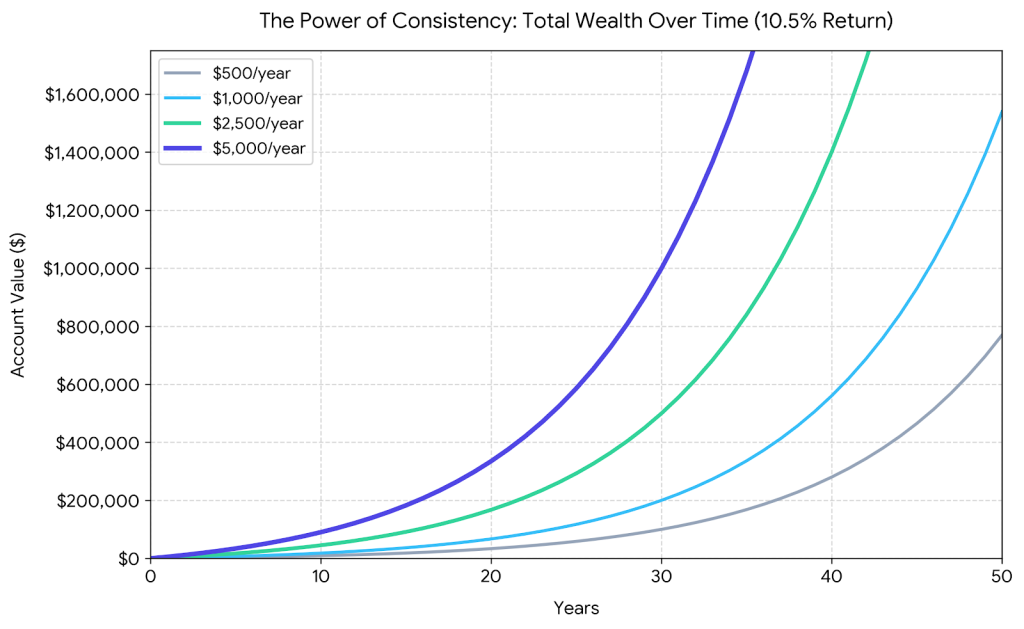
The key for most individuals to become millionaires isn’t intelligence, luck, hedge funds, paying for a stock broker/brokerage, or using artificial intelligence; it is persistence. Common short-cuts will only delay financial goals. That means you need to have persistence in managing money, budgeting, investing (dollar-cost averaging), saving, living below your means, and limiting material possessions or impulse buying. Often, the more you follow basic principles of investing combined with gaining financial literacy over time, the faster you will achieve millionaire status.
A 2023 article by Matz, Gladstone, and Farrokhnia studied low-income individuals and their saving habits by using an app designed to encourage savings. The researchers found that aligning savings goals to subjects’ personality traits improved savings rates. In fact, subjects with a “personality-matched condition” were over 3.5 times more likely to achieve a targeted savings amount. Bottom line, discover a financial guide that provides strategies or savings goals matching your unique personality. My financial literacy improved significantly once I started regularly listening to podcasts by Clark Howard and David Stein, because their methods matched my personality and investment style.
People assume you need to have a six-figure salary to invest. That is simply not true as people in any income bracket can become millionaires by following a consistent, long-duration approach. As this article points out in the beginning, $83.33 per month can result in $1.5 million over a 50-year time frame. Look for yourself using our Compound Growth Calculator.
During my personal journey to financial freedom, I saved between 50-65% of my salary for investment purposes. I didn’t make six figures until the last 5 years of my career. In fact, I had a modest salary for the first 12 years of my 20-year working career. But I was a persistent investor focused on retiring by 45.
If early retirement is a goal, consider investing in multiple buckets such as Roth IRA, 401k/403b, IRA, emergency fund, and a taxable brokerage account. Most early retirees without a significant pension need a taxable account to bridge the gap during the early years of retirement.
You don’t need complex strategies, luck, a high-fee advisor, or a huge salary to invest. Utilize consistency and time, combined with finding a financial resource that matches your personality.
References: Matz, S. C., Gladstone, J. J., & Farrokhnia, R. A. (2023). Leveraging psychological fit to encourage saving behavior. American Psychologist, 78(7), 901–917.
Leave a Reply