
Author: Ty Druse
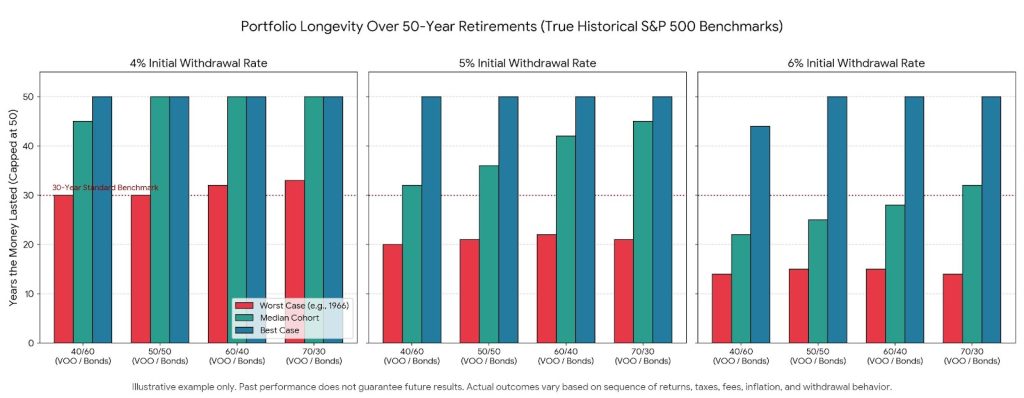
Now that we have a better understanding of the historical context of [Bengen’s 4% rule] and how to determine withdrawal rates, let’s take a look at the below chart. The chart illustrates worst-case scenarios over the past 100 years of data, based on investing in the S&P 500 (Vanguard S&P 500 ETF- VOO) and intermediate-term Treasuries (bonds). There are three charts representing 4%, 5%, and 6% withdrawal rates respectively, with different mixes of stocks and bonds in each chart.
Key takeaways:
- Stock/Bond Mix: 4% withdrawal rate is successful at lasting 30 years regardless of the mix of stocks and bonds (40/60 to 70/30).
- Equity Cushion: 60/40 and 70/30 mixes actually performed better than the conservative 40/60 and 50/50 options during worst-case scenarios with a 4% withdrawal rate.
- 50-Year Plans: If individuals plan to retire for greater than 30 years, asset mix and withdrawal rates require adjustments. During worst-case historical events, none of the mixed investments lasted a full 50 years.
- Beneficiary Planning: Investors desiring to leave significant assets to beneficiaries should consider adjusting to a more aggressive equity (stock) tilt.
- Extending Retirement: Consider lowering the initial withdrawal rate below 4% if your retirement timeline goals exceed 30 years.
Those pursuing or considering FIRE (Financial Independence, Retire Early) by applying the 4% rule should proceed with caution. Significant market downturns and/or high inflationary times may result in individuals exhausting their assets prior to death. The 4% rule was intended for 30 years of retirement. Investors can input their own retirement plan in the [Retirement Spending Calculator] found here at seedtoinvest.com.
Other items to consider when investing are future returns and international investing. Will the significant national debt of the United States lead to higher taxes and/or inflation, potentially reducing the S&P 500 returns? Are the historically high prices of US equities going to negatively affect future US market returns? If investors believe either to be true, consider diversifying away from relying solely on the US market into a mix of funds including international assets. Vanguard’s VT fund is comprised of 60% US market, with the remaining balance in international assets. While international equities (Vanguard’s VT) have historically shown slightly lower median returns compared to the S&P 500, diversifying globally protects a portfolio from country-specific fiscal risks, such as U.S. inflation or changes to corporate tax structures.
Bengen’s 4% rule was a true gem that’s lessons can still be applied today!
References: Bengen, W. P. (1994). “Determining withdrawal rates using historical data.” Journal of Financial Planning, 7(4), 171–180.
Leave a Reply